
I Like Me
Loving Ourselves as we Love Our Neighbors

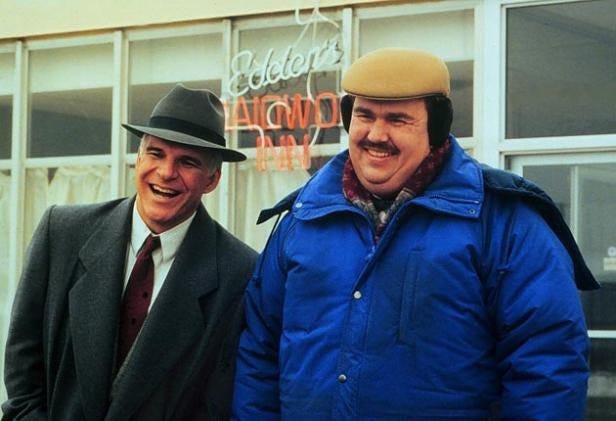
In 1994, at the age of only 43, the world lost one of its most loveable, silly, and talented entertainers. Known for his roles in classic films like the Blues Brothers, Home Alone, National Lampoon’s Vacation, the Great Outdoors, Cool Runnings, and Planes, Trains, and Automobiles, John Candy was a beloved presence in the comedy circuit and on the big screen. Known for his large physique, which made him in many ways even more endearing to his fans, he died in Mexico after suffering a heart attack. At some points in his life, his weight had climbed to 375 pounds. Paired with a family history of heart problems (his father died of a heart attack at the age of 35 on his fifth birthday), his longtime recreational use of alcohol and cocaine, and his habit of smoking a pack of cigarettes a day, his weight added to the toll on his body, and his heart ultimately gave out. An alumnus of the Second City improv troupe, he was a skilled improvisor and performer. In one of his marquee roles, that of Del Griffith alongside Steve Martin’s Neal Page in John Hughes’ Planes, Trains, and Automobiles, Candy provided a very moving monologue that ultimately became the title for a 2025 documentary about his life. During the scene, a visibly hurting Griffith tells an angry and annoyed Page, “I like me. My wife likes me. My customers like me. ‘Cause I’m the real article. What you see is what you get.” Reflecting on this monologue, especially during this time of Lent, how many of us can truly echo the sentiment of Candy’s character, and say definitively that we like ourselves?

Candy indeed was a loveable guy, and to this day, many of his friends and costars talk about how much they loved him and miss him. Still, his delivery of that monologue portrays the possibility that even someone as cherished and as loveable as Candy could struggle to accept himself for who he was. For so many of us it is sometimes so much easier to be loved by others than it is to be loved by ourselves. That’s probably why his monologue speaks to so many of us. It’s a silly movie, but that’s one of the most touching, emotional moments in cinema. Why does this seem to be the case? Why do so many of us feel so broken? So wrong in our existence? So unlovable? It’s an age-old question and it’s one I wish society would work harder to eradicate. While most Christians are familiar with Jesus’s Summary of the Law, which reminds us that the second of the Great Commandments is to love your neighbor as yourself (Matt. 22:39), we sometimes neglect the fact that this commandment represents a two-way street. What good does it do to love our neighbor as we love ourselves, after all, if we don’t truly love ourselves?
There are so many factors that can impact our ability to love ourselves. A lot of times, humans have a tendency to internalize the negative comments made by others at our expense. My own grandsons are learning about the harsh reality that their peers can be mean. At the ages of six and eight, they have become targets of school age bullying for things that bring them joy, or even for their physical traits. Like Candy, for much of my life, I have been teased because of my weight. It took finding a peer group of similarly sized people on my high school football team to feel like I was in some way “normal”. Some people are belittled because of their physical abilities or even disabilities. Some are mistreated because of gender, race, sexuality, hair color, eye color, they’re too tall, too short, too fat, too thin. In the United States, we see a visible representation of this when we look at the gender pay gap. American women are paid only 83 cents for every dollar earned by a male. This gap widens for women of color. Black women earn 70 cents, and Latina women earn 65 cents for every dollar earned by a white male. We are bombarded with messages, audible and inaudible, all the time. If we’re not careful, then our brains can internalize these types of negative messages, and convince our psyches that we are inherently flawed. What does it take to be considered “good enough”? What does it take for us to believe in ourselves? What does it take to be like Del Griffith, and to be able to say with confidence, “I like me”?
Sometimes it takes a willingness to buck the trend. To do things that are unexpected. To trust our own instincts, even when some particularly loud voices would prefer we didn’t. At this point in my life, a whole year older now than Candy was when he died, I can say that if someone treats me badly or disrespects me, it says a whole lot more about them than it does about me. Am I perfect? No. Not even close. But does that matter? Not to me. None of us is perfect. Except for Jesus, of course. And it was his perfection that threatened people to the point where they put him up on a cross. But it took me more than 40 years of doing difficult self-work to reach a point where I can say that with confidence. If someone doesn’t like the shoes I decide to wear for instance, then guess what? That person doesn’t have to look at them.
I know I’m not everyone’s cup of tea. I don’t try to be. I don’t have a need to be. Even among my clergy peers, I’m a little… let’s call it… different. I’ll put it this way. If you hear the words “Episcopal priest”, the image that pops into your brain is not likely to be a goofy guy wearing an aloha shirt, shorts, and shoes with Mickey Mouse on them. I fondly remember the day I attended Eucharist at St. Mary the Virgin, nicknamed “Smokey Mary’s” in Manhattan, and not a single person would talk to me (I assume based on my attire). To be fair, I was unfamiliar with Smokey Mary’s at the time, and I only chose to attend there because it was the closest parish to my hotel. Had I known about it, I would have either dressed differently or found another parish that would be more approving of casual clothing. But I can reminisce about that experience and acknowledge that I was merely being me. If “me” wasn’t what the people at Smokey Mary’s were interested in, then that’s on them. I can’t be (and I won’t be) someone other than who I am. And here’s the thing: I don’t want you to be someone other than who you are, either.

In Paul’s letter to the Galatians, he writes, “For freedom Christ has set us free,” (Galatians 5:1). But this seems to indicate some kind of paradox. The Christian idea that our submission to Christ can somehow mean we are more free. How is this possible? And I would say it’s because of our inherent imago Dei. We can’t possibly see the divine image in ourselves if we are not aware of the Divine. It’s a lot harder to recognize our inherent goodness if we miss the mark on recognizing the God who created us. It can be an important tool to remember our own imago Dei, because if we do, we remember that we are pretty well obligated to treat ourselves with kindness. Remember how Jesus tells us, “Truly I tell you, just as you did it to one of the least of these brothers and sisters of mine, you did it to me” (Matthew 25:40)? Well. That includes ourselves. How we treat others is indeed indicative of how we treat Jesus. But how we treat ourselves is also indicative of how we treat Jesus.
Performers like John Candy touch our lives because they bring themselves into the role. When I watch Del Griffith deliver that monologue, and I look into his eyes, Candy does such a good job of encapsulating the pain that his character obviously feels after Neal’s attack. The connection comes in the moment of shared humanity. We probably have all been there! We probably all have felt hurt by a friend or a loved one. In fact, it hurts so much worse when harmful words come from someone we love than from someone we don’t care about. It takes vulnerability to acknowledge the pain we feel. We have a human need to protect ourselves. And vulnerability can lead us to feel exposed.
I am very intentional in my ministerial efforts to meet people where they are. What I try to model is acceptance for who a person is, along with separating the person’s humanity from their behavior. Someone on death row is not a murderer. Someone on death row is a human being who committed a murder. The human person of John Candy was not an actor. The human person of John Candy was a human being who acted. Our English language is limiting because adjectives that describe our behaviors become nouns that replace our humanity. The person working at 7 Eleven isn’t a clerk. But because that person’s role in that case is to function as a clerk, that person becomes known as a clerk. But clerk is merely a role that person plays. That person is a human being with human emotions. I am a person. A person who functions as a priest. But I’m so much more than merely a priest. The person I am is bigger than any single role I play. The same is true about you.
Do you feel silly because you like to eat the same foods frequently or you like to wear excentric clothing or glasses that are bigger or more colorful than glasses that others wear? Do you prefer to be more reserved in your appearance? Do you prefer to wear your hair long? Do you like it better short? Wanna know something really cool? We get to decide! And we should decide for ourselves. Will people like it? That piece isn’t important. We can only be more free if we submit to the imago Dei within us. The uniqueness bestowed upon us by our God. If we can reach a point where this becomes easier, then let’s share that with others! Let’s model for others permission to be themselves.
Here’s a piece of clarifying information. Remember how we distinguish a behavior from our identity? That is something to pay attention to. When we love others as ourselves, we must always be mindful of behaviors that respect the dignity of others in our lives. When it comes to clothing, for instance, we need to be mindful of the context of our place. It could be seen as offensive to the people of St. Mary’s, for instance, if I intentionally entered that church without dressing for the environment. We also want to respect modesty standards. The Vatican has dress codes for a reason. Not to limit our humanity, but to respect the sacredness of the place and to keep us from distracting others. We do have to be mindful of how our presence impacts those around us. If I like to say four-letter words, and you don’t like to hear them, then it’s probably kind of me to refrain from using that type of language as a means of supporting your dignity. Make sense? It’s complicated, I know. And it takes effort to find a balance. But it can be done. We have to give ourselves grace to make mistakes, and space and encouragement to learn and grow from our mistakes. While we will never achieve perfection, that is a standard we ought to try to aspire toward.
John Candy’s on-screen and improv performances connect with us because they remind us of ourselves. We find anecdotes humorous because we’ve done those same things. We’ve all had obnoxious members of our extended families, like Candy’s Chet Ripley finds in Dan Aykroyd’s Roman Craig in the Great Outdoors. We’ve all had our past mistakes suggest controversy for people we care about, like Irv Blitzer’s did in Cool Runnings. We’ve all tried to be a comforting presence to a grieving person like Gus Polinski did in Home Alone, only to realize our words were making things worse and not better. We’ve been there. We are the real deal. What you see is what you get. But it’s our shared humanity that makes for solid human connection. As we continue our journey through Lent, may we be ever mindful of our shared humanity. And may we make it a goal to love God and to love our neighbors as ourselves, remaining mindful that loving ourselves deeply is a piece of the equation.
I so agree with your words. At 92, I' m still searching (and learning too, I hope)
I struggle with liking me. So, this reflection really hits home.