
I Don't Know
Developing a Willingness to be Curious

Author’s Note: I apologize for the recent inconsistency in my posting patterns. I’ve had some interesting developments in my life lately (all good, but all time consuming!), and they have required a lot of focus. I have had a number of speaking opportunities, out of town meetings, and churchwide and diocesan events. I hope to try to resume publishing more frequently in the future. Maybe you didn’t even notice, and this note is actually only for me. But if you did notice, and you’ve been missing me, well… I’ve missed you, too!
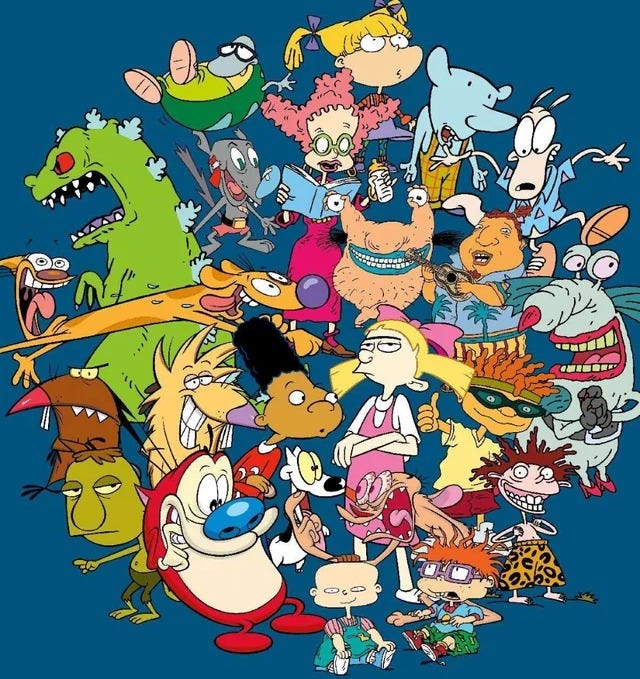
Like many kids of my generation, I grew up in the early days of the television network called Nickelodeon. In many ways, Nickelodeon branded itself as something of an “anti-Disney”. These days, the Nickelodeon of the late 80s and early 90s has developed something of a cult following. There are now countless popular documentaries, podcasts, and websites dedicated to celebrating Nickelodeon and its new take on entertainment for children that moved away from cutesy cartoons and educational content that kids did not always find to be engaging.
While Disney featured a lot of wholesome content, and PBS brought kids educational series like Mr. Rogers’ Neighborhood, Sesame Street, and Reading Rainbow (all of which are wonderful, by the way!), Nickelodeon took a different approach at attempting to reach kids who, like all of us, appreciate more than one kind of entertainment. Its cartoons featured fart jokes and potty humor. One of its shows, Salute Your Shorts, is quite literally named after a supposed summer camp hazing ritual of raising someone’s underwear on a flagpole. Double Dare, its marquis game show, was known for encouraging kids to get as messy as possible. The Adventures of Pete and Pete featured a small child named Pete (his older brother was also named Pete) with a tattoo of a provocatively dressed woman who would dance when he flexed his arm, causing Pete’s mother to faint when she saw it. Clarissa Explains it All featured a female lead in Melissa Joan Hart, which was almost unheard of even as recently as the 90s. And Hey Dude, filmed right here in Arizona on the property of Tucson’s Tanque Verde Ranch, featured kids goofing off, getting into mischief, and learning important life lessons about hard work and friendship. But it was one of Nickelodeon’s first television shows, a series produced in Canada called You Can’t Do That on Television, that put Nickelodeon on the map. To this day, the network’s signature slime logo is a nod to a recurring gag in the children’s sketch comedy series, made in the image of Rowan and Martin’s Laugh-In.
In You Can’t Do That on Television, kids were sometimes punished for being, well, kids. They were kept in dungeons for not finishing their homework. They were made to eat food they didn’t particularly care for because, well, that’s what was being served. And most famously, they were slimed for saying the words, “I don’t know.” We know that humor is often intended to raise awareness about causes that are otherwise uncomfortable to talk about. One thing You Can’t Do that on Television got right is the fact that there’s a lot of wisdom in lampooning the idea of punishing someone for admitting they don’t know something.

Why were kids on the show “punished” for saying they don’t know? Why are so many of us humans ashamed to admit we don’t know things? Why is it seen as a sign of weakness to yield to someone who knows something that perhaps we don’t? Why do so many people value absolute certainty to the extent that they’re willing to either make something up or otherwise just go along with some nonsensical explanation someone shared with them that they saw on a rage-bait YouTube video? Here’s the answer: I don’t know.
All we need to do if we want to see this phenomenon at work is to scroll social media for about ten minutes. Depending on what our algorithm wants us to see, we will find people claiming to share absolute certainty about religion, health, politics, economics, morality, sexuality, psychology, and more. What is the problem with this? Well. There are many. But the biggest is that most of this advice doesn’t come from experts. It comes from people who are filling in the blanks with assumptions, misinformation, or even conspiracy theories. And when this bad information gets stuck in an echo chamber, and enough people become convinced of something that simply isn’t true, then we end electing (and then even re-electing) someone like Donald Trump to become the president of the United States. In fact, Donald Trump is probably one of the worst offenders when it comes to saying things that aren’t true while subsequently convincing people that they are. Remember in the debate when he falsely claimed Haitian immigrants were eating pets in Ohio? Well. People believed him. The Haitian community faced discrimination and violence because of the false claims, and countless people have been emotionally scarred by the reality that a former (and now sitting) American president peddling racist tropes that rile up his voting base. As we can see, believing someone just because they say something with conviction in their voice is dangerous.
Here is the paradox of writing about such a topic: Why should you believe me? Well, for one thing, I don’t think it’s a good idea to believe me blindly. When I make a claim, it comes from having researched it by reviewing reputable sources. I also encourage you to be skeptical and to double-check what I say. To me, that’s a big difference. For example, while there are zero known cases of Haitian immigrants having kidnapped and eaten family pets in Ohio, there are plenty of documented cases of Haitian immigrants being treated poorly following Trump’s comments. And, as LeVar Burton used to say in the aforementioned Reading Rainbow, you don’t have to take my word for it. In fact, don’t! Look it up! Using credible sources, of course. Not just some dude in a podcast who is trying to make money for being “extreme.” Look up sources. Actual news sources. Don’t believe me. Believe the experts.
Admitting we don’t know is a strength. Making something up so that we look like we do know when we don’t is foolish. It also can cause a lot of damage. We can find ourselves going down a rabbit trail of continuously covering our tracks to an extent where we don’t even know what it is that we don’t know any more. At the same time, acknowledging we don’t know something encourages us to do something productive about it. If we don’t know something, and we want to know something, we can do research about it and we can learn. And after we learn, guess what happens? We no longer have to say we don’t know. Because now we know! Pretty neat, huh?
As a priest and pastor, I do not know everything about ministry, theology, scripture, Christian history, liturgy, etc. Not even close. Obviously there have to be some things that stick. We pastors do have to know certain things off the tops of our heads. But any pastor who claims to know everything all at the same time is not being truthful. If you’ve been to my office, then you’ve seen dozens of books. I also subscribe to publications from around the Church. And I have access to libraries from my universities through alumni associations. Something I do have that is even better than knowledge is access to the knowledge. And the most important skill I have as a priest is the ability to know how to research a topic.
Is this immediately gratifying to someone who has a pressing question? Maybe not. Is it much more helpful than me saying something that is potentially incorrect? Absolutely! I might say, “You know, I’m not sure about the answer. Here’s what I think it likely is, but if you don’t mind, I can research it and get back to you!” And that usually works out just fine! Or, even better, I can say, “I don’t know for sure, but why don’t you join me in my office or the library and we can look together?” That way, you can have a better idea of how to find the answers. You also know that I’m not making something up.
Making something up can be far more dangerous than getting the proverbial bucket of slime dumped on us for not knowing something. For instance, I get a lot of internet trolls who call me a “heretic”, throwing around the word like it actually means something. I mean, it does. But it doesn’t mean what they think it means. A heresy is an active rejection of Christian orthodoxy. For instance, saying the Trinity is not one God in three persons. Or saying that Jesus is subordinate to God the Father (see Arianism). I will even go so far as to say that heresies aren’t inherently bad. They merely aren’t in line with what the Christian Church has determined to be orthodox teachings. But these internet trolls think a “heresy” is anything they don’t agree with. For instance, they call me a heretic for supporting LGBTQ affirmation or for supporting women in active, ordained ministry roles in the Church. These are NOT heresies. They are teachings some denominations follow. But they are not orthodox Christian Church teachings.
The best litmus test for heresy is the Nicene Creed. If a teaching violates the Creed, then there’s a good chance it is heretical (remember, not bad. Simply not orthodox.) But saying there are two sacraments instead of seven (or the other way around), saying women can be ordained a deacons, priests, and bishops, or performing same-sex marriages are NOT heresies. Calling them heresies makes these trolls look foolish. What’s the bigger problem? Well, if they convince enough people that they are right, then people will believe that I’m a “heretic” for reasons that I am not a heretic.
In the Hans Christian Andersen tale the Emperor’s New Clothes, the title character loves clothing. He commissions a swindler to produce “magical” clothes that can only be seen by people who are intelligent. No one can see the clothes, but it isn’t because they are unintelligent. It’s because there are no clothes. And it takes a small child to point this out, as everyone else is too embarrassed to admit they see no clothing. The first person to admit this would also have to be admitting they are unintelligent. But the irony is that had they admitted it in the first place, everyone would have been spared the embarrassment of having seen their ruler parade around naked. Going along with the status quo out of fear of rejection can have major consequences. Consequences far worse than being called a name by an internet troll.
We don’t know what we don’t know. There’s no way we can. And we shouldn’t have to worry about being punished (slimed or otherwise) because we don’t know something. We should be encouraged to continue to learn. As we learn, we grow. But we’re not required to know things we can’t possibly know. This means we need to encourage others to learn and to grow as well. If we have access to information that someone else can benefit from, then it’s kind to share it. Irish philosopher Geroge Bernard Shaw famously said, “If you have an apple and I have an apple and we exchange these apples then you and I will still each have one apple. But if you have an idea and I have an idea and we exchange these ideas, then each of us will have two ideas.” The same is true for the passing of knowledge. Sharing our knowledge with others costs us nothing. We simply need to be mindful about sharing knowledge that is truthful and not made up.
There is absolutely no shame in not knowing. There is especially no shame in acknowledging that we don’t know. As Anne Lamott famously said, “the opposite of faith is not doubt, but certainty.” When we are overly confident about things we don’t know about, we can cause some real problems. When we acknowledge we have much to learn, we become empowered to work toward a better understanding. Do we think the world’s finest universities would be worth their high tuition costs if freshman students entered with all the knowledge they would one day need? Of course not! It is through our faith that we can seek true understanding. Recognizing that we don’t always know is human. And through our shared humanity, we can work to develop a deeper relationship with each other and with the God who loves us beyond our capacity to understand. Even when we get it wrong, and even when we don’t know.
Knowledge is power. Age is wisdom. You can't believe everything you hear or read. Be diligent and do research before you jump on a bandwagon.